Drainage Water Recycling
Practice Overview
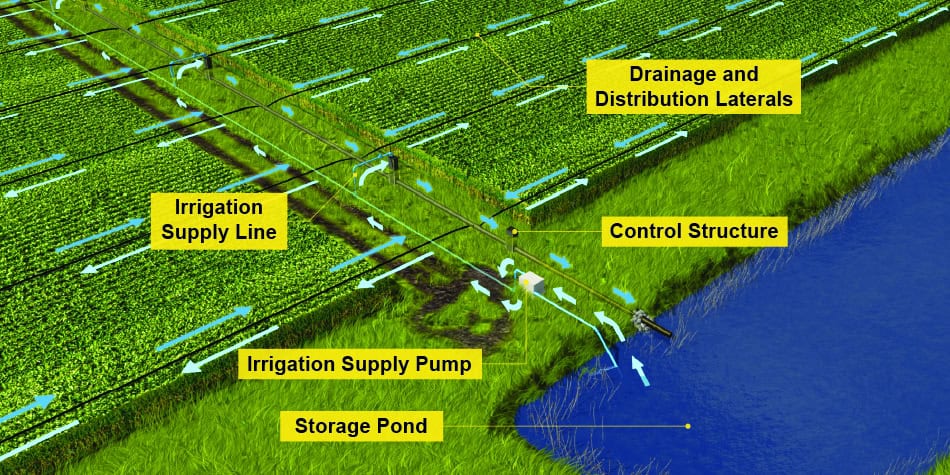
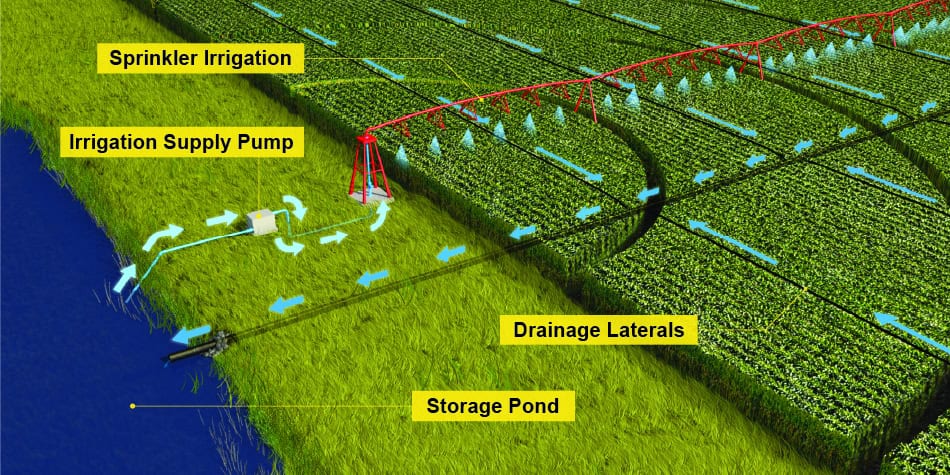
Agricultural drainage water from periods of excess moisture is stored in a reservoir to be reused as irrigation water during dry periods of the growing season when crops need it the most.
Benefits
Reusing farm field drainage water offers significant benefits for the land and the people that depend on it, including:
- Higher and more consistent yields
- Reduced nutrient loss
- Improved downstream water quality
Components of a Drainage Water Recycling System
To create a system that effectively and efficiently collects, stores, and redistributes drainage water, you’ll need:
- Storage pond — a pond to collect and store drainage water for reuse
- Supply line — feeds reused water to the irrigation system
- Laterals — small diameter pipe that removes excess moisture from the field and returns water to the field when used as part of a subsurface irrigation system
- Control structure — controls the release of drainage water into the storage pond, and in a subsurface irrigation system, controls the flow of water back into the field
- Mainline — a large diameter pipe that conveys water from the laterals to the control structure, and in a subsurface irrigation system, distributes the water back into the laterals
- Pump — for moving water from the storage pond into the irrigation system
How It Works
The timing and amount of rain rarely match up with timely field access (planting, harvesting, etc.) and crop water needs. Usually, there is either too much or too little water at the wrong time. Drainage water recycling captures excess water from the drainage system and stores it in a purpose-built pond to use for irrigation in dry periods. Stored water can be reused in subsurface, pivot and other types of irrigation systems. With less water leaving the site, more nutrients and sediment remain behind, benefiting the field and crops.
Installation Considerations
- Most effective on flat fields
- Depending on storage pond, water may need to be filtered prior to irrigation
- Incorporate overflow in the storage pond design
- Power needed on site for pumps
Resources & Funding
- TWT Podcast, Episode #113: How Drainage Water Recycling Benefits Irrigation and Public Water Quality (Video)
- NRCS Code 447 – Irrigation and Drainage Tailwater Recovery
- Transforming Drainage – Drainage Water Recycling
- Transforming Drainage – Subirrigation Suitability Tool
- Transforming Drainage – Decision Tool